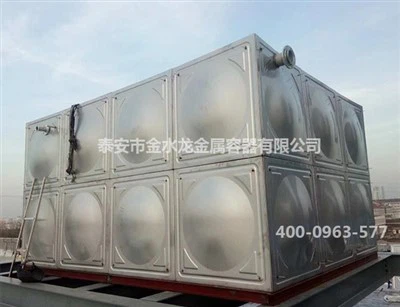
Single-walled stainless steel storage tanks. Most single-walled tanks have a simple, cylindrical construction, with horizontal or vertical orientation options. These storage tanks offer high-level corrosion resistance to internal and external corrosive agents, and are commonly accompanied by a concrete structure as a secondary method of containment.
Double-walled stainless steel storage tanks. These tanks feature a primary tank with a secondary wall built around it to protect against fluid leakage. They are ideal for petrochemical applications and EPA compliance. Some varieties contain insulation to safeguard against heat transfer from external temperature variations.
Stainless steel clad tanks. As an alternative to pricey tanks with thick stainless steel construction, single- or double-side cladding a carbon steel tank with thin stainless steel sheets adds corrosion resistance to the tank.
Jacketed stainless steel storage tanks. Used in conjunction with cooling towers or boilers, a jacketed steel tank allows fluid to pass through the area between two plates of stainless steel, cooling or heating the tank contents as required without mixing with them.
Stainless steel process tanks. These tanks help process the substances they store by dissolving, mixing, or otherwise agitating tank contents. To achieve this, process tanks may utilize a variety of tools like paddles or mixing heads. For added versatility, some process tanks come with specialized features like insulation, dual walls, and monitoring devices for a tank's level, pressure, and temperature.
High-pressure stainless steel storage tanks. For high-pressure applications, stainless steel adds the strength necessary to ensure safe operation. High-pressure stainless steel storage tank fabrication should follow strict standards like the ASME Boiler and Pressure Vessel Code.
Compressed air tanks. Stainless steel is ideal for compressed air tanks for its corrosion resistance, given that the tank will be exposed to air and moisture. With the immense pressure contained in these tanks, they must be strong for serving as air buffer or receiver containers. Again, quality tanks will conform to the ASME Boiler and Pressure Vessel Code.