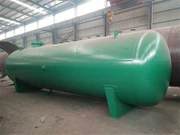
Common Application Scenarios Of The Deoxygenation Tower Reflux Tank
Dec 13, 2025
Pre-treatment of Naphtha in Petroleum Refining
In the petrochemical ref industry, especially when preparing raw materials for catalytic reforming units, the deoxygenation tower reflux tank is one of the key equipment in the naphtha pre-reatment unit (pre-hydrogenation unit).
•Core purpose: During storage and transportation, raw naphtha dissolves a small amount of oxygen. Under subsequent hightemperature hydrogenation conditions, oxygen can trigger a series of oxidation polymerization reactions, generating sediment, leading to equipment blockage, catalyst poisoning, and increased system pressure drop. Therefore, it must be effectively removed before hydrogenation.
•Workflow: After naphtha enters the deoxygenation tower, it is heated and vaporized, and light components such as dissolved oxygen are discharged from the top of the tower. These gaseous materials are cooled and condensed by a deoxygenation tower top cooler (such as a circulating cooler) and then enter the deoxygenation tower top reflux tank. In the reflux tank, gas, liquid (oil), and water are separated in three phases: separated non-condensable gas (containing oxygen, light hydrocarbons) is discharged to the flare network; the liquid phase part is returned to the top of the deoxyation tower as reflux through a reflux pump to maintain the mass transfer efficiency in the tower; the separated water is discharged from the water package at the bottom of the tank. system can be adapted to different raw materials and processing requirements by controlling the top pressure of the tower (such as low-pressure operation about 0.05MPaG or operation about 0.45MPaG).
Specific Applications in Chemical Production
In some chemical plants, equipment with similar principles also plays an important role, sometimes the function of resource recovery.
•Cyclohexanol production: In the cyclohexanol unit, the water separated from the separation tower reflux tank water package isoxygenated high-purity water. This part of the water has excellent water quality and can be directly recycled and sent to the cyclohexene hydration reaction system as water for use, replacing part of the network deoxygenated high-purity water. This not only saves fresh water consumption and production costs but also reduces the load of theewater treatment system.
•Butadiene production: In the acetonitrile method for producing butadiene, the de-light tower reflux tank is used to deoxygenation inhibitor. This application gives the de-light tower, which originally did not have the function of deoxygenation, the ability to deoxygenate effectively reducing the generation of butadiene peroxides and polymers and ensuring the safe and stable operation of the unit.
Key Application Points and Trends
https://www.vacuumtechglobal.com/storage-tank/chemical-storage-tank/deoxygenation-tower-reflux-tank.html
In actual application the following points are crucial for the efficient and stable operation of the deoxygenation tower reflux tank, reflecting the development trend of the technology:
•Precise control of package level: This is the core to ensure separation effect and prevent the reflux tank from "carrying water" affecting the operation of the reflux pump or "running oil" material loss. Modern units often use automatic control systems, monitoring the water package level through remote-transmitted level gauges and automatically adjusting the opening of the control valve on the drain to achieve precise water cutting, greatly reducing the frequency of manual operation and the risk of operational errors.
•Energy saving and consumption reduction and system optimization: It is an important to reduce energy consumption through process optimization. For example, by using the high-temperature deoxygenated naphtha at the bottom of the deoxygenation tower to exchange with the incoming cold naphtha, only one heat exchanger can complete the main heat exchange task, reducing equipment investment and footprint, while increasing the feed temperature and reducing the energy of the subsequent heating furnace. Some improved processes also introduce dry gas (such as low molecular weight methane and ethane) to reduce the oxygen partial pressure and even try to stop using steam reboiler to save energy even further.